CBSE Class 12 Physics Exam Analysis 2026 OUT: Difficulty Level, Students’ Reactions & Paper Pattern
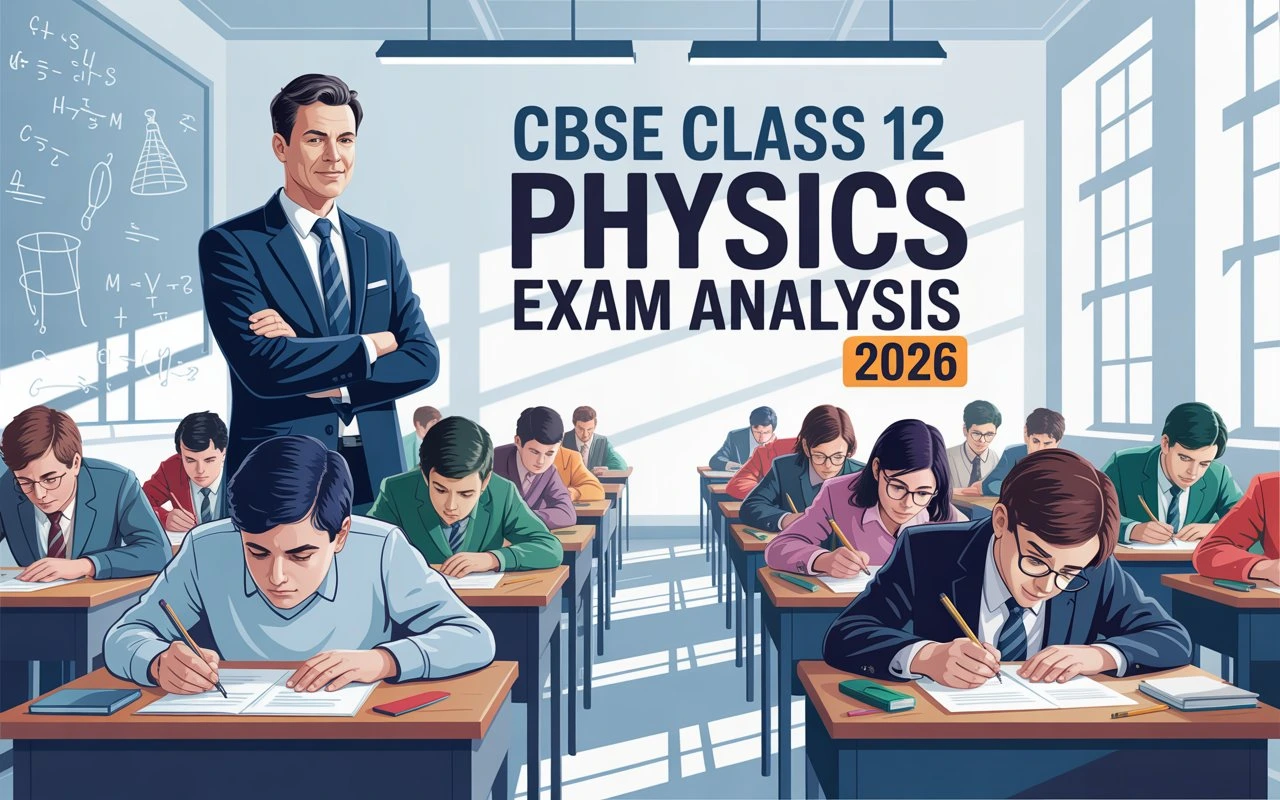



The CBSE Class 12 Physics Exam 2026 was conducted successfully on February 20, 2026, from 10:30 AM to 1:30 PM. According to students and teachers, the paper was overall moderate in difficulty, balanced, and strictly based on the NCERT syllabus.
However, many students felt the paper was slightly lengthy, especially due to multi-step numericals and case-study questions.
Most questions tested conceptual understanding and application skills, rather than direct memorisation. Students who prepared well from NCERT textbooks, previous year papers, and sample papers found the exam manageable.
_rvw6jJ4.webp)
This CBSE 12 Physics 2026 analysis will help students understand the paper pattern, difficulty level, and overall review.
As per the CBSE Class 12 Physics paper review, the overall difficulty level was moderate. The paper was not extremely difficult, but it required good conceptual clarity and time management.
A quick overview:
Feature | Analysis |
| Overall Difficulty | Moderate |
| Numericals | Lengthy and application-based |
| Theory Questions | Concept-focused |
| Time Management | Challenging for some students |
| Syllabus Coverage | Fully NCERT-based |
Most questions were based on NCERT concepts, and no out-of-syllabus questions were reported. However, students needed to apply concepts properly, especially in numerical and case-study questions.
The exam followed CBSE’s competency-based format, which focuses on testing real understanding rather than rote learning.
The question paper followed the official CBSE pattern. The exam was conducted for 70 marks, and all questions were compulsory. The paper was divided into five sections.
Section | Question Type | Number of Questions | Marks per Question | Total Marks |
| Section A | MCQ and Assertion–Reason | 16 | 1 | 16 |
| Section B | Very Short Answer | 5 | 2 | 10 |
| Section C | Short Answer | 7 | 3 | 21 |
| Section D | Case Study | 2 | 4 | 8 |
| Section E | Long Answer | 3 | 5 | 15 |
| Total | 33 | 70 |
This pattern was similar to the CBSE sample papers released earlier, which helped students who practised them regularly.
Section A: MCQs and Assertion–Reason (16 Marks)
This section included multiple-choice questions and assertion–reason questions. Most questions were concept-based and directly related to NCERT.
Some assertion–reason questions were slightly tricky and required proper understanding of concepts. Students who studied NCERT line-by-line found this section scoring.
Difficulty Level: Easy to Moderate
Section B: Very Short Answer Questions (10 Marks)
This section included short questions that tested basic concepts and simple calculations.
Questions were mostly direct and student-friendly. Students who understood basic formulas and definitions were able to answer easily.
Difficulty Level: Easy
Section C: Short Answer Questions (21 Marks)
This section included both theory and numerical questions. Some questions required multiple steps and proper calculations.
Many students reported that this section was slightly time-consuming because it required careful solving and correct units.
Difficulty Level: Moderate
Section D: Case Study Questions (8 Marks)
The case-study section tested students’ understanding of real-life applications of physics concepts.
Questions were mainly from topics like:
Students needed strong conceptual clarity to answer these questions correctly.
Difficulty Level: Moderate
Section E: Long Answer Questions (15 Marks)
This section included three long-answer questions, mainly from important chapters such as:
Most derivations were expected and based on NCERT. Students who practised derivations and understood concepts found this section scoring.
Difficulty Level: Moderate
As per the CBSE 12 Physics 2026 analysis, most questions were asked from high-weightage chapters.
Important chapters included:
Many questions were directly or indirectly based on NCERT examples and exercises. This shows the importance of studying NCERT thoroughly.
Students had mixed reactions to the exam.
Some students said the paper was moderate and manageable, while others felt it was lengthy due to numericals and case-study questions.
Common student feedback included:
One student mentioned that the questions were fair but lengthy. Another student said the paper was manageable because they had practised sample papers and previous year questions.
Students who had strong concepts and good practice were able to complete the paper comfortably.
Teachers described the paper as well-balanced and aligned with CBSE guidelines.
According to subject experts:
Teachers also noted that students who relied only on memorisation may have found some questions challenging.
Overall, the Class 12 Physics paper review suggests that students with strong fundamentals and regular practice could perform well.
The CBSE Class 12 Physics answer key 2026 will help students check their answers and estimate their scores.
The answer key includes:
This helps students analyse their performance and understand their mistakes.
Eduzia Learning will also provide a detailed answer key soon and expert solutions to help students review the exam properly.
Board exams like CBSE Class 12 are important milestones in every student’s academic journey. Proper guidance, concept clarity, and regular practice play a key role in achieving good results.
Eduzia Learning provides personalized one-on-one online tuition for CBSE students from Classes 1 to 12. Our expert teachers focus on building strong concepts, improving problem-solving skills, and helping students prepare confidently for exams.
With Eduzia Learning, students get:
Eduzia Learning helps students build confidence and perform better in school exams and board exams. Contact us today!
The overall difficulty level was moderate. The paper was balanced but required good conceptual understanding and time management.
Yes, the paper was completely based on the NCERT syllabus. Most questions were directly or indirectly from NCERT concepts.
Numericals were not very difficult, but some questions were lengthy and required multiple steps, which made them time-consuming.
Important chapters included Electrostatics, Current Electricity, Magnetism, Optics, EMI, and Modern Physics.
Yes, some students reported that the exam was slightly lengthy, especially due to numerical and case-study questions.
Eduzia Learning provides one-on-one online tuition with expert teachers. Students receive personalized attention, concept clarity, and proper guidance for school and board exams.
Yes, Eduzia Learning offers specialized tuition for CBSE Class 11 and 12 students, helping them understand concepts and perform better in exams.
Eduzia Learning focuses on personalized teaching, flexible schedules, and concept-based learning, ensuring every student gets individual attention.
Yes, Eduzia Learning provides fully online tuition, allowing students to learn comfortably from home.
Students can enroll easily by registering through Eduzia Learning and start learning with expert teachers.